Who dated Charles Maurice de Talleyrand-Périgord?
Princess Dorothea of Courland dated Charles Maurice de Talleyrand-Périgord from ? until ?. The age gap was 39 years, 6 months and 19 days.
Germaine de Staël dated Charles Maurice de Talleyrand-Périgord from ? until ?. The age gap was 12 years, 2 months and 20 days.
Adélaïde Filleul, Marquise de Souza-Botelho dated Charles Maurice de Talleyrand-Périgord from ? until ?. The age gap was 7 years, 3 months and 12 days.
Dorothea von Medem dated Charles Maurice de Talleyrand-Périgord from ? until ?. The age gap was 7 years, 0 months and 1 days.
Maria Teresa Poniatowska dated Charles Maurice de Talleyrand-Périgord from ? until ?. The age gap was 6 years, 9 months and 26 days.
Mademoiselle Luzy dated Charles Maurice de Talleyrand-Périgord from until . The age gap was 6 years, 7 months and 27 days.
Charles Maurice de Talleyrand-Périgord

Charles-Maurice de Talleyrand-Périgord (; French: [ʃaʁl mɔʁis də tal(ɛ)ʁɑ̃ peʁiɡɔʁ, moʁ-]; 2 February 1754 – 17 May 1838), 1st Prince of Benevento, then Prince of Talleyrand, was a French secularized clergyman, statesman, and leading diplomat. After studying theology, he became Agent-General of the Clergy in 1780. In 1789, just before the French Revolution, he became Bishop of Autun. He worked at the highest levels of successive French governments, most commonly as foreign minister or in some other diplomatic capacity. He served as the French representative to the Congress of Vienna. His career spanned the regimes of Louis XVI, the years of the French Revolution, Napoleon, Louis XVIII, Charles X, and Louis Philippe I. Those Talleyrand served often distrusted him but found him extremely useful. The name "Talleyrand" has become a byword for crafty and cynical diplomacy.
Talleyrand was Napoleon's chief diplomat during the years when French military victories brought one European state after another under French hegemony. Most of the time, he worked for peace so as to consolidate France's gains. He succeeded in obtaining peace with Austria through the 1801 Treaty of Lunéville and with Britain in the 1802 Treaty of Amiens. He could not prevent the renewal of war in 1803 but by 1805 he opposed his emperor's renewed wars against Austria, Prussia, and Russia. He resigned as foreign minister in August 1807, but retained the trust of Napoleon. He conspired to undermine the emperor's plans through secret dealings with Tsar Alexander I of Russia and the Austrian minister Klemens von Metternich. Talleyrand sought a negotiated secure peace so as to perpetuate the gains of the French Revolution. Napoleon rejected peace; when he fell in 1814, Talleyrand supported the Bourbon Restoration decided by the Allies. He played a major role at the Congress of Vienna in 1814–1815, where he negotiated a favorable settlement for France and played a role in unwinding the Napoleonic Wars.
Talleyrand polarizes opinion. Some regard him as one of the most versatile, skilled, and influential diplomats in European history, with a clear-eyed and realistic view of the French national interest. Others, on the other hand, see him as a serial turncoat seeking only his own advantage, betraying the ancien régime, the French Revolution, and Napoleon in turn for his own gain.
Read more...Princess Dorothea of Courland

Dorothea von Biron, Princess of Courland, Duchess of Dino, Duchess of Talleyrand and Duchess of Sagan, known as Dorothée de Courlande or Dorothée de Dino (21 August 1793 – 19 September 1862), was a Baltic German noblewoman, and the ruling Duchess of Sagan between 1845 and 1862. Her mother was Dorothea von Medem, Duchess of Courland, and although her mother's husband, Duke Peter von Biron, acknowledged her as his own, her true father may have been the Polish statesman Count Aleksander Batowski. For a long time, she accompanied the French statesman Charles Maurice de Talleyrand-Périgord; she was the separated wife of his nephew, Edmond de Talleyrand-Périgord.
Read more...Charles Maurice de Talleyrand-Périgord
Germaine de Staël

Anne-Louise-Germaine Necker, baronne de Staël-Holstein, connue sous le nom de Madame de Staël (/stal/), est une romancière, épistolière et philosophe genevoise et française née le à Paris où elle est morte le .
Issue d'une famille de protestants valdo-genevois aisée, elle est la fille du ministre des finances de Louis XVI Jacques Necker, et de Suzanne Curchod qui tient un salon littéraire et lui donne accès à un savoir encyclopédique. Elle épouse, en 1786, le baron Erik Magnus Staël von Holstein, ambassadeur du roi Gustave III de Suède auprès de la cour de France à Versailles. Le couple se séparera en 1800. Devenue baronne de Staël, elle mène une vie sentimentale agitée et entretient en particulier une relation orageuse avec Benjamin Constant, écrivain et homme politique franco-vaudois rencontré en 1794.
Entretemps, sa réputation littéraire et intellectuelle s'est affirmée grâce à trois essais philosophiques que sont les Lettres sur les ouvrages et le caractère de Jean-Jacques Rousseau (1788), De l'influence des passions sur le bonheur de l'individu et des nations (1796) et De la littérature considérée dans ses rapports avec les institutions sociales (1800).
Favorable à la Révolution française et aux idéaux de 1789, elle adopte une position critique dès 1791 et ses idées d'une monarchie constitutionnelle la font considérer comme une opposante gênante par les maîtres de la révolution. Malgré le statut de diplomate de son mari, elle doit se réfugier auprès de son père en Suisse à plusieurs reprises. Interdite de séjour sur le sol français par Napoléon Bonaparte qui la considère comme un obstacle à sa politique, elle s'installe en Suisse dans le château familial de Coppet qui sert de lieu principal de rencontres au groupe du même nom, et d'où elle fait paraître Delphine (1802), Corinne ou l'Italie (1807) et De l'Allemagne (1810/1813).
Veuve en 1802, elle se remarie en 1811 avec un jeune officier genevois, Albert de Rocca, et rouvre son salon parisien à la faveur de la Restauration de la maison de Bourbon.
Grâce à la publication de De l'Allemagne (1813-14), elle popularise en France les œuvres des auteurs de langue allemande, jusqu'alors relativement méconnues. Elle ouvre ainsi la voie au romantisme français, directement inspiré des premiers romantiques allemands et anglais. Ses œuvres fictionnelles majeures, dans lesquelles elle représente des femmes victimes des contraintes sociales qui les enchaînent, sont Delphine (1802) et Corinne ou l'Italie édité à Londres en 1807 et 1808 par Jean-Gabriel Peltier.
Elle meurt en 1817, peu de temps après une attaque de paralysie qui la terrasse au cours d'un bal que donnait le duc Decazes, laissant inachevées ses Considérations sur les principaux événements de la Révolution française, ouvrage posthume publié en 1818, ainsi que ses Dix années d'exil, parues à titre posthume en 1821.
Read more...Charles Maurice de Talleyrand-Périgord
Adélaïde Filleul, Marquise de Souza-Botelho
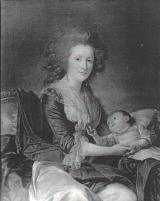
Adélaïde-Émilie (sometimes Émilie-Adélaïde) Filleul, Marquise de Souza-Botelho (14 May 1761 – 19 April 1836) was a French writer.
Read more...Charles Maurice de Talleyrand-Périgord
Dorothea von Medem

Countess Anna Charlotte Dorothea von Medem (3 February 1761 – 20 August 1821) was born a Gräfin (Countess) of the noble Baltic German Medem family and later became Duchess of Courland. Popularly known as Dorothea of Courland after her marriage to Peter von Biron, the last Duke of Courland, she hosted an aristocratic salon in Berlin and performed various diplomatic duties on behalf of her estranged husband. She would spend the rest of her life in her estate in Löbichgau, where she would invite and host many important political and cultural figures of the time. She made many acquaintances, ranging from Goethe to Napoleon I of France to Talleyrand, the latter of whom she was reportedly very close to.
Read more...Charles Maurice de Talleyrand-Périgord
Maria Teresa Poniatowska

Maria Teresa Antoinette Josephine Poniatowska (28 November 1760, Vienna, then under the Habsburg monarchy, now Austria – 2 November 1834, Tours, France) was a Polish noblewoman. She was the niece of king Stanisław August Poniatowski and sister of Prince Józef Poniatowski.
Read more...Charles Maurice de Talleyrand-Périgord
Mademoiselle Luzy
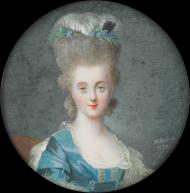
Dorothée Dorinville, stage name Mademoiselle Luzy (1747–1830), was a French stage actress.
She was engaged at the Comédie-Française in 1764. She became a Sociétaires of the Comédie-Française in 1764. She retired in 1781.
She was most known as a soubrette, but also performed tragedy, and acted as a singer and dancer. She was described as a serious and ambitious stage artist, and was a part of the movement that wished to introduce realistic stage costumes. She was imprisoned in 1771 after having broken the censure laws in a play by Imbert.
Read more...