Who dated Catherine Bagration?
Klemens von Metternich dated Catherine Bagration from ? until ?. The age gap was 9 years, 8 months and 23 days.
Catherine Bagration
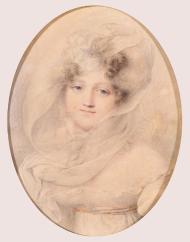
Catherine Bagration, född 7 februari 1783, död 21 maj 1857, var en rysk salongsvärd. Hon var i sin samtid känd som skönhetsikon, för sin excentricitet och för sitt äventyrliga liv. Hon ryktas ha varit hemlig rysk agent, agerade informell diplomat för antifransk och prorysk politik och ska ha medverkat till att Österrike anslöt sig till koalitionen mot Napoleon I. Hon höll salong i Wien 1810-15 och i Paris från 1815.
Dotter till greve Paul Martinovitj Skavronskij, sändebud i Neapel, och Jekaterina von Engelhardt, som var systerdotter till Potemkin. Hon blev gift i slottskyrkan i Gatchinapalatset den 2 september 1800 med general furst Pjotr Bagration i ett äktenskap arrangerat av tsaren. Hon ska vid vigseln ha varit förälskad i greve P. Palena. År 1805 lämnade Catherine Bagration maken och reste till Europa, där hon stannade under förebärande av sin hälsa. Hon reste mellan hoven och blev en känd gestalt i hela Europas societetsliv. Hon kallades "Le Bel Ange nu" ("naken ängel") på grund av sin förkärlek för genomskinliga klänningar och "Chatte Blanche" ("Vit Katt") - för sin sinnlighet. Hon hade ett förhållande med prins Metternich och höll en prorysk och antinapoleonsk salong i Wien. Hon genomdrev en bojkott av franska ambassaden i Wien och ska som informell diplomat ha medverkat till att Österrike anslöt sig till koalitionen mot Napoleon. Under Wienkongressen 1814 hade hon, då kallad "ryska Andromeda ", ett förhållande med tsaren tillsammans med "Cleopatra Kurland" (Wilhelmine av Kurland). Enligt samtida rapporter ska dock tsaren snarare ha haft affärsmöten med henne, då hon möjligen var en rysk agent, även om det inte har bevisats. Hon 1815 till Paris, där hon öppnade salong och blev bekant med Balzac. Hon gifte sig 1830 med brittiska generalen och diplomaten Caradoc, Lord Howden (Sir John Hobart Caradoc, 2nd Baron Howden av Howden och Grimston) (1799 - 1873).
Read more...Klemens von Metternich

Klemens Wenzel Nepomuk Lothar, Prince of Metternich-Winneburg zu Beilstein (15 May 1773 – 11 June 1859), known as Klemens von Metternich ( MET-ər-nikh, German: [ˈkleːmɛns fɔn ˈmɛtɐnɪç]) or Prince Metternich, was a German statesman and diplomat in the service of the Austrian Empire. A conservative, Metternich was at the center of the European balance of power known as the Concert of Europe for three decades as Austrian foreign minister from 1809 and chancellor from 1821 until the liberal Revolutions of 1848 forced his resignation.
Born into the House of Metternich in 1773 as the son of a diplomat, Metternich received a good education at the universities of Strasbourg and Mainz. Metternich rose through key diplomatic posts, including ambassadorial roles in the Kingdom of Saxony, the Kingdom of Prussia, and especially Napoleonic France. One of his first assignments as Foreign Minister was to engineer a détente with France that included the marriage of Napoleon to the Austrian archduchess Marie Louise. Soon after, he engineered Austria's entry into the War of the Sixth Coalition on the Allied side, signed the Treaty of Fontainebleau that sent Napoleon into exile and led the Austrian delegation at the Congress of Vienna that divided post-Napoleonic Europe amongst the major powers. For his service to the Austrian Empire, he was given the title of Prince in October 1813.
Under his guidance, the "Metternich system" of international congresses continued for another decade as Austria aligned itself with Russia and to a lesser extent Prussia. This marked the high point of Austria's diplomatic importance and thereafter Metternich slowly slipped into the periphery of international diplomacy. At home, Metternich held the post of Chancellor of State from 1821 until 1848 under both Francis I and his son Ferdinand I. After a brief exile in London, Brighton, and Brussels that lasted until 1851, he returned to the Viennese court, only this time to offer advice to Ferdinand's successor, Franz Josef. Having outlived his generation of politicians, Metternich died at the age of 86 in 1859.
A traditional conservative, Metternich was keen to maintain the balance of power, particularly by resisting Russian territorial ambitions in Central Europe and the Ottoman Empire. He disliked liberalism and strove to prevent the breakup of the Austrian Empire, for example, by crushing nationalist revolts in Austrian northern Italy. At home, he pursued a similar policy, using censorship and a wide-ranging spy network to suppress unrest.
Metternich has been both praised and heavily criticized for the policies he pursued. His supporters pointed out that he presided over the "Austrian system" when international diplomacy helped prevent major wars in Europe. His qualities as a diplomat were commended, some noting that his achievements were considerable in light of the weakness of his negotiating position. Meanwhile, his detractors argued that he could have done much to secure Austria's future, and he was deemed a stumbling block to reforms in Austria. Metternich was also a supporter of the arts, taking a particular interest in music; he knew some of the most eminent composers in Europe, including Haydn, Beethoven, Rossini, Paganini and Liszt.
Read more...